Moscow Diaries – Day 1 of 4 · By Anant Agarwal, Co-founder & Chef, Daily Foodzz · 15 September 2026
Every exhibition looks the same from the outside. A booth, a banner, a table of samples, a stack of brochures. What actually separates a good show from an expensive one is what happens in the ninety seconds after someone stops walking.
WorldFood Moscow 2026 Day 1 is done, and it has been – by a clear margin – the strongest opening day we’ve had at any international exhibition. Not because of footfall. Because of the depth the conversations reached.
Here’s an honest account of the day, written the same evening, while it’s still fresh.
We Started This Show a Month Ago, Not This Morning
This is the change we made this year, and it’s the reason Day 1 felt different.
In previous exhibitions we did what most of the hall does – booked the stall, printed the material, packed the samples, and waited. This time we started reaching out roughly a month before the show. We looked for the importers, distributors and private-label partners in the Russian market whose requirements actually match what we manufacture, introduced ourselves properly, shared our range, and asked for a slot at the booth. Not a mass mailer – specific conversations with specific companies.
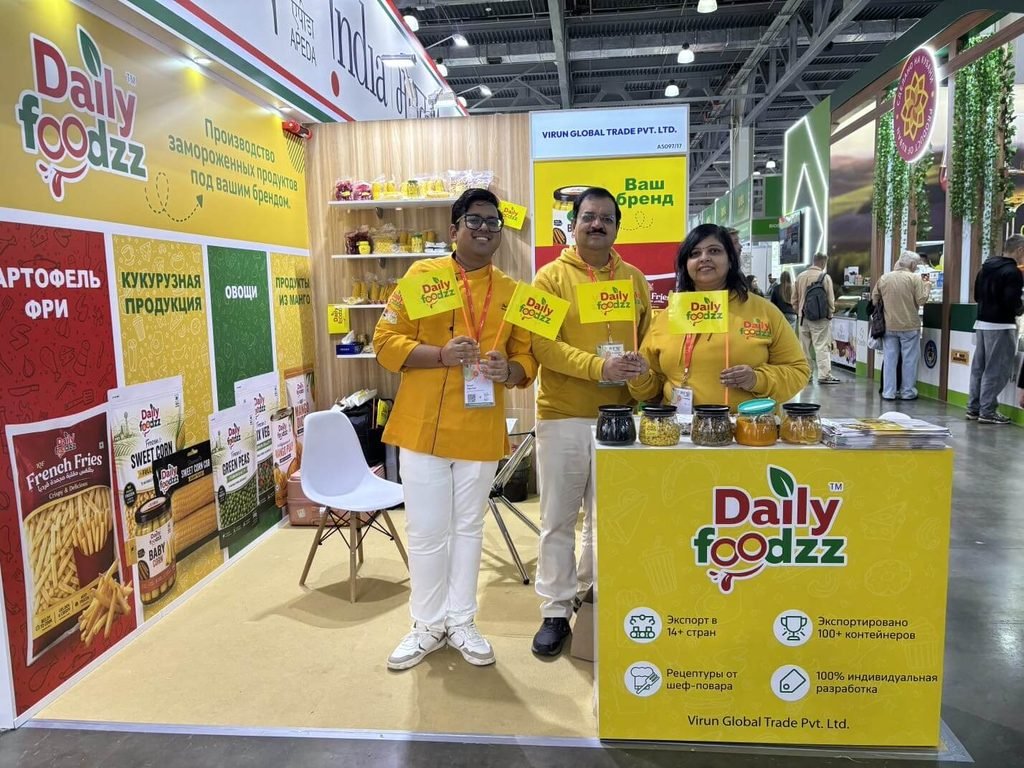
The effect was visible from the first hour. Several people arrived at our counter already knowing our name and our category, carrying a question they’d already thought about. That changes the nature of the conversation entirely. You skip the ten minutes of explaining who you are and start at specifications, volumes and terms.
We’d rather do it this way. If you’ve travelled to a trade fair, your time on the floor is expensive – and so is ours. Starting a month early means neither of us spends it on introductions.
The Most Useful Thirty Minutes of Our Day
The most valuable thing that happened today wasn’t an enquiry. It was a complaint – not about us, about the category.
The same frustration came up again and again on the floor: frozen French fry quality is inconsistent, and you can’t tell until it’s too late.
If you’ve had that experience, the reason is structural. In the frozen state, one fry looks like any other. Same colour, same cut, same pack. You can open a sample carton and learn almost nothing. The difference only reveals itself after frying – and by then the container has landed, the payment has cleared, and the fries are in a kitchen where a chef is quietly deciding never to reorder that brand.
I trained as a chef before I ran this business with my family, so the fryer end of this is where I’ve spent most of my working life. What separates a good fry from a poor one after it hits the oil isn’t luck. It’s six things, and all of them are controllable at the factory.
1. The potato itself. Variety, dry matter content and reducing sugars decide colour and taste in the fryer. High sugars caramelise too fast and give you dark ends and a bitter note. Dry matter decides whether the fry is substantial or watery. And storage temperature before processing changes the sugar profile – so two lots of the same variety can behave completely differently.
Our control: we specify variety and dry matter range, test incoming lots for sugar profile, and control pre-processing storage rather than accepting whatever the season delivers.
2. Blanching. This sets the internal structure and washes out surface sugars. Under-blanch and the centre is hollow and mealy. Over-blanch and the fry goes limp.
Our control: time and temperature fixed per lot, adjusted to that lot’s sugar reading – not run to one standing recipe all season.
3. Par-frying. The par-fry builds the shell. Inconsistent par-frying is the most common reason one carton fries beautifully and the next one doesn’t.
Our control: monitored oil temperature and dwell time with batch records, so a deviation is caught in our plant instead of your kitchen.
4. The coating. This is the one that gets underestimated. Coating doesn’t decide whether a fry is crisp – it decides how long it stays crisp. A fry leaves the fryer and reaches the table several minutes later. If it’s soft by then, nothing else about the product matters.
Our control: we formulate for hold time rather than the first thirty seconds. If you’re supplying HORECA, tell us your service window and we’ll match the coating to it.
5. Oil uptake. A poorly processed fry drinks oil. That’s a cost line in the kitchen and a heavy, greasy texture on the plate.
Our control: surface moisture and par-fry parameters managed to keep uptake down – and we’ll give you the figure rather than a claim.
6. Cold chain integrity. Every temperature fluctuation between our plant and your warehouse grows ice crystals. Ice crystals rupture cell walls. Ruptured cell walls fry soggy. The pack will look perfect. The plate won’t.
Our control: blast freezing to core temperature, packed to hold it, with transit conditions specified for the route – including the longer Russia and CIS legs.
None of that is visible at a trade fair table. Which led to a decision we took on the floor today:
Not a tasting bowl prepared backstage. Frozen in, hot out, in front of you – crisp, evenly coloured, holding texture eight minutes later. If the whole category’s credibility problem is that the truth only appears after frying, then the sensible thing is to fry where you can watch.
If you’d rather not wait for the next show, ask us for a sample and fry it yourself, in your own kitchen, at your own oil temperature. That’s the real test, and almost nobody runs it.
Ganpati Bappa at Stand A5097/17
It’s Ganpati festival season back home in India. There was never a question of leaving that behind because we happened to be in Moscow.
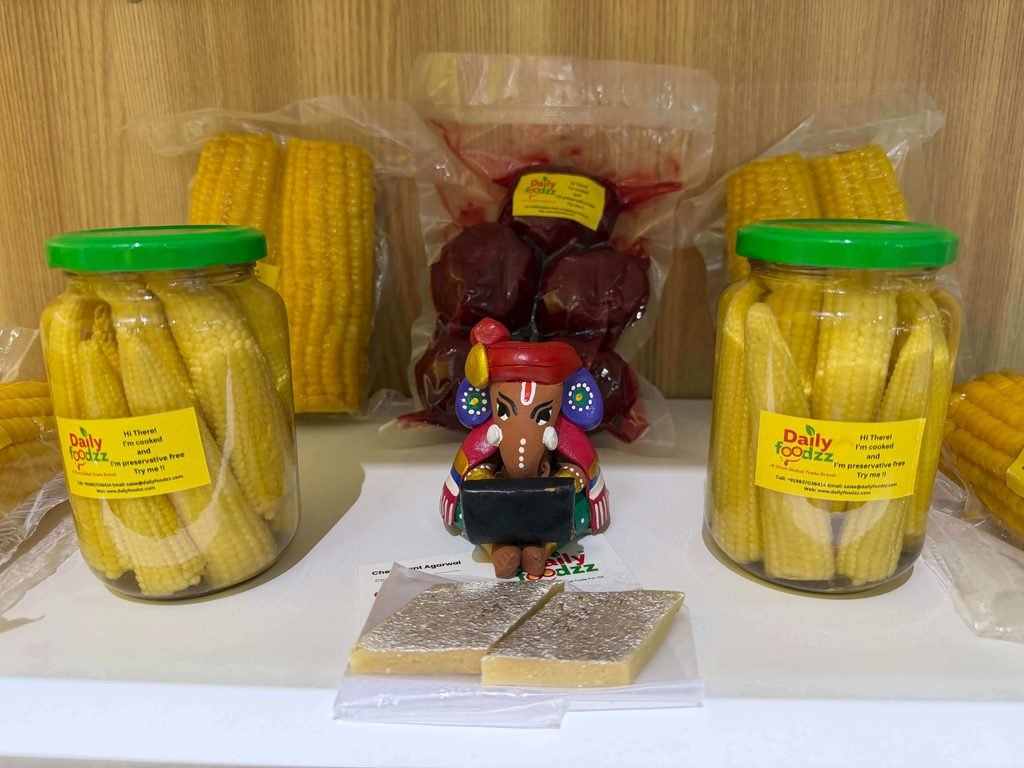
So Bappa travelled with us. Our stall has a Ganpati idol, and we’ve kept the rituals going through the exhibition days – quietly, in the middle of a trade fair, seven thousand kilometres from home.
It’s done something we didn’t plan for. People ask about it. Russian visitors, European visitors, the teams on neighbouring stands – they stop, they look, and they ask what the festival means. And suddenly you’re not two companies negotiating a price per metric tonne. You’re two people talking about where you’re from.
We extended the same thought to everyone who sat down with us for a proper conversation – each of them left with a Rajasthani hand-printed dupatta or a Banarasi bag. Real Indian craft, not conference merchandise with a logo slapped on it.
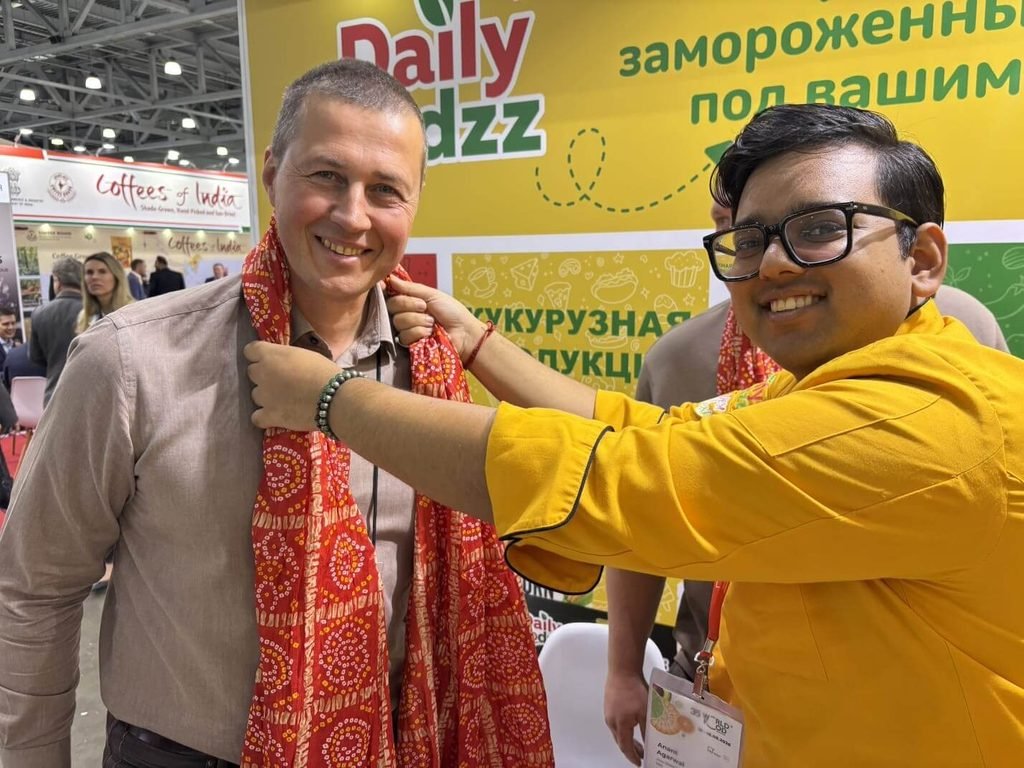
What genuinely made our day: they carried them. All day. Around the hall, into other stands, through the aisles. We kept spotting our bags moving across the exhibition floor hours after those meetings ended.
We Hired a Russian Translator, and It Changed the Depth of Every Conversation
A practical decision that paid for itself several times over today.
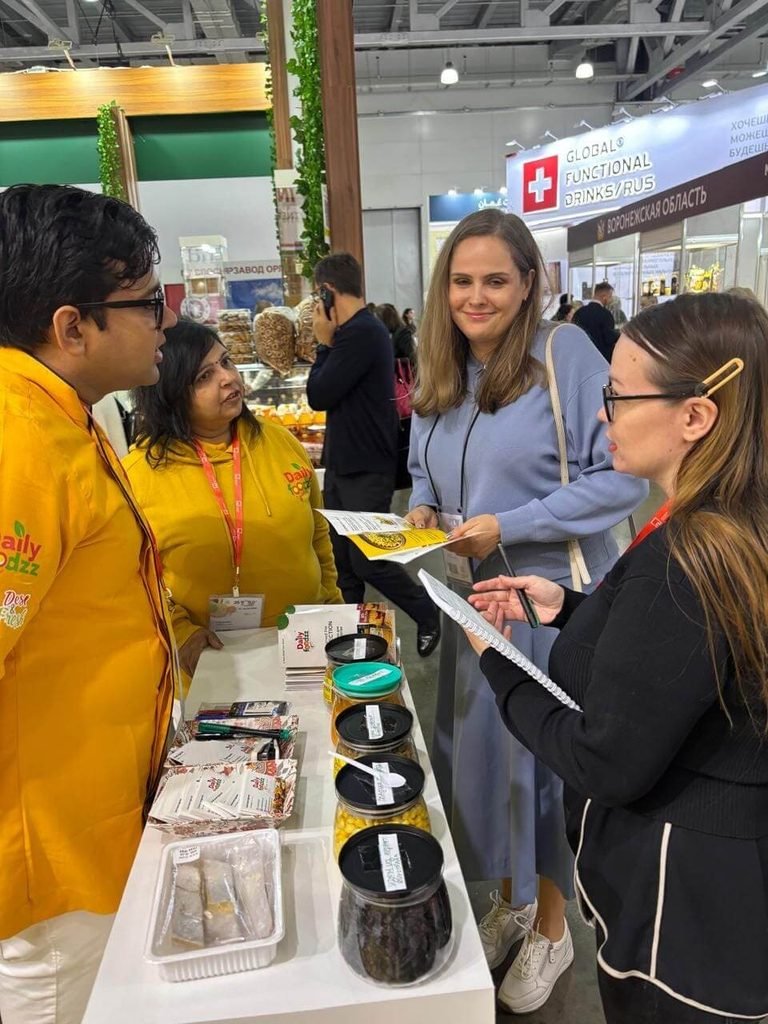
We brought a dedicated Russian translator onto the stand for the full duration of the show. Not a phone app. A person, standing with us, all day.
It matters more than it sounds. In broken English, a conversation stops at “interesting, send me a price.” With a translator, it goes where it needs to go – into pack sizes for hypermarket shelves versus bulk formats, into certification documents, into cold chain and transit timelines, into what a current supplier is getting wrong, into payment structures.
So if you’re at the show and you want to go deep on specifications, come to the stand and go as deep as you like. Nothing will get lost on the way.
The Recognition
We have been recognized by Ministry of Commerce & Industry, Government of India; APEDA. You can read more about it here
References: Press Release | Department of Commerce | APEDA | News on Air
Four Questions That Came Up All Day
Stripped of the small talk, today’s conversations clustered around four things. Our answers, plainly:
1. “Can you make it under our brand?”
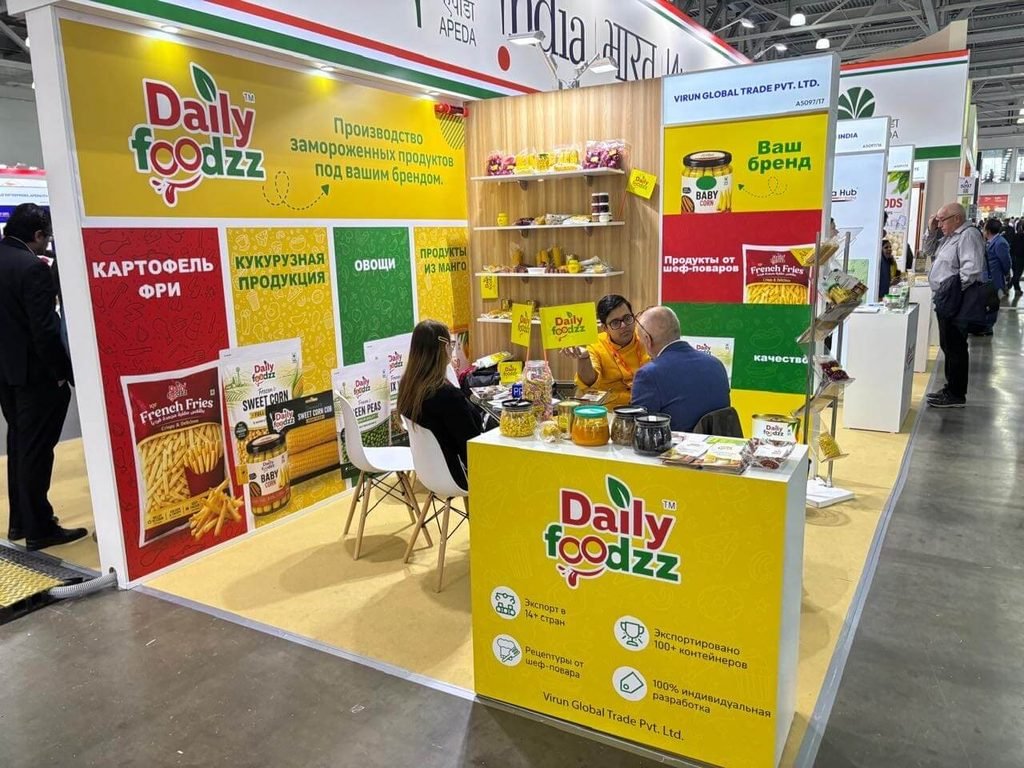
Yes – that’s most of what we do. Recipe development, pack format, label design for your market, 100% custom formulation. Our stand carries a dedicated Ваш бренд (Your Brand) section for exactly this reason.
2. “Will batch ten be the same as batch one?”
This is the fair question, and it’s the one the six controls above exist to answer. Specification at intake, parameters adjusted per lot, batch records kept. If you want to see the records rather than a certificate, ask – a certificate says a plant did it once, records say it does it every time.
3. “Can you adapt the product to us?”
Nearly all of it is adaptable. Pack sizes for your retail shelf, formats suited to local kitchens, recipe adjustments for local palates. We develop to your specification rather than pushing a fixed catalogue at you.
4. “Who are you, exactly?”
We manufacture. Daily Foodzz is the brand of Virun Global Trade Pvt. Ltd. – exports to 14+ countries, 100+ containers shipped, chef-developed recipes. The person answering your process question at the counter is the person responsible for it at the plant.
Tomorrow: Dinner and a BSM With the Russian Embassy
Day 1 ends with an invitation we’re genuinely pleased about – Daily Foodzz has been invited to a dinner and Buyer-Seller Meet hosted by the Russian Embassy tomorrow.
These rooms are where a conversation that started at a booth turns into something more structured. We’ll go in the way today worked: fewer pitches, more listening, and real answers to technical questions. If you’re attending, find us there.
What We’re Taking Into Day 2
- Starting early works. We’ll keep building the conversation list well ahead of the next show rather than relying on the floor to produce the right people.
- Fry live. The commitment we made on the floor today stands – a fryer on the stand at the next exhibition, and samples to anyone who wants to run the test themselves before then.
- Being unmistakably Indian is an asset. Ganpati on the stand, craft in people’s hands, chef knowledge behind the counter.
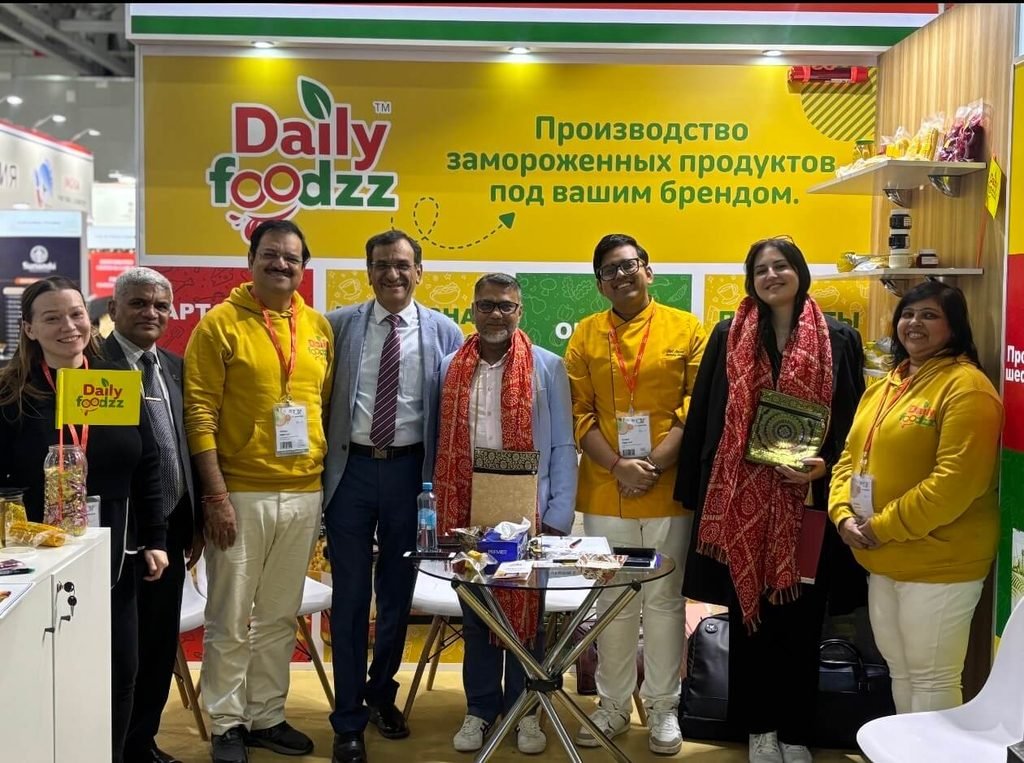
We’ll post a recap like this at the end of every day until the show closes on 18 September. If you’re at WorldFood Moscow, come find us – Daily Foodzz, Virun Global Trade Pvt. Ltd., Stand A5097/17, in the India/APEDA pavilion. Bappa’s there too.
Come and taste, or ask us for a sample to fry in your own kitchen.
– Anant, Daily Foodzz
Frequently Asked Questions
Where can I meet Daily Foodzz at WorldFood Moscow 2026?
Stand A5097/17 in the India/APEDA pavilion, until 18 September 2026. A Russian translator is on the stand throughout the show.
Why is frozen French fry quality inconsistent between suppliers?
Because the differences are invisible in the frozen state. Potato variety, dry matter and reducing sugars, blanching, par-frying consistency, coating formulation, oil uptake and cold chain integrity all determine the finished fry, but only become apparent after frying.
Why do some frozen fries lose their crispness before reaching the table?
Crisp retention is determined mainly by the coating formulation and the par-fry process. A fry can be crisp leaving the fryer and soft four minutes later if the coating wasn’t formulated for hold time. Cold chain fluctuation in transit adds ice crystal damage, which also produces a soggy result.
How can I assess frozen fry quality before placing an order?
Fry the sample in your own kitchen at your own oil temperature, then assess it again after eight minutes to test crisp retention. Ask for batch production records rather than a one-off certificate, and ask how the supplier handles a potato lot that arrives outside specification.
Does Daily Foodzz manufacture under a buyer’s own brand?
Yes. Private label with 100% custom formulation, including recipe development, pack format and label design for the destination market.
What does Daily Foodzz manufacture?
Frozen French fries, IQF sweet corn, baby corn, green peas, mixed vegetables, retort corn on the cob, frozen Indian snacks including samosa and paratha, and mango products. Daily Foodzz is a brand of Virun Global Trade Pvt. Ltd., exporting to over 14 countries with 100+ containers shipped.